Monday, April 9, 2012

Vicuña


The Life of Animals | Vicuña | The vicuña is a delicate and graceful than the guanaco, and smaller. An essential element distinguishing feature of the morphology of the better-developed incisor roots for guanaco.Its long, woolly coat is tawny brown on the back, while the hair is white on the throat and chest and fairly long. The head is slightly shorter than the guanaco and the ears are a little longer. Vicuñas live exclusively in South America, especially in the central Andes. They are originally from Peru, north-west of Argentina, Bolivia and northern Chile, and there is a small, introduced population in central Ecuador. The rays of the sun are in a position to the thin atmosphere produces relatively warm temperatures to penetrate during the day, however, temperatures drop to freezing at night. The vicuña's thick but soft coat is a special adaptation, can tolerate the layers traps warm air close to his body to freezing temperatures. The behavior of the vicuña is similar to the guanaco.

Like the guanaco, they are frequently lick calcareous stones and rocks that are rich in salt, and drink is also salt water.  Vicuñas live in family-based groups of one male, taken 5-15 females and their young. Young males form bachelor groups and young women to join the search for a fraternity. Along with preventing intraspecific competition, it also prevents inbreeding, which has a population bottleneck in endangered species can cause as observed with cheetahs. The wool is renowned for its warmth. Its warming properties of the tiny scales that are on the hollow air filled fibers come. At the same time it is finer than any other wool in the world, measuring 12 microns in diameter  but because they are sensitive to chemical treatment, the wool is usually left in its natural color. During the time of the Incas, vicuna fiber is called by local efforts Chacu were assembled, where crowds of people herded hundreds of thousands of vicuña into previously defined funnel traps.


From June 2007, prices for vicuña yarns and fabrics of $ 1,800 to $ 3,000 per meter range. Vicuña fiber for clothing (including socks, sweaters, accessories, scarves, coats, suits and) and home fashion (such as blankets and throws) are used. A scarf costs about $ 1,500, while a man's coat cost up to $ 20,000. 
 

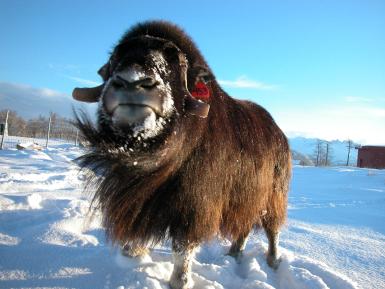
Musk ox


The Life of Animals | Musk ox | The thick coat and large head often suggests a larger animal than the musk ox is really heavy but have kept zoo specimens weighed up to 650 kg (1,400 lb). Musk oxen are occasionally domesticated for wool, meat and milk of the wool, Qiviut is prized for its softness, length and insulation value. Musk oxen are native to the arctic regions of Canada, Greenland and the United States. The musk ox successfully in the Taimyr Peninsula in 1975, reintroduced during the summer, muskoxen live in wet areas to avoid, such as river valleys, moving to higher altitudes in the winter of deep snow. Musk oxen feed on grasses, Arctic willows, shrubs, lichens and mosses. Musk oxen have a high level of fat reserves before conception that reflects their conservative breeding strategies. Winter ranges tend to have shallow snow to reduce reach to find the energetic cost of digging through snow for food. Predators of musk oxen are Arctic wolves, grizzly bears and polar bears. Musk oxen live in herds, the number of 12 to 24 in winter and in summer 20.08 do not you own territories, but they mark their tracks with pre-orbital glands of male and female musk oxen have both separate age hierarchies with mature oxen as dominant over young people.

Muskox bulls maintain their dominance in many different ways. Bulls roar too, swinging their heads and sometimes paws ground.Dominant cops treat subordinate bulls as cows. A dominant bull is an afterthought, a minor kick with their front legs, to do something which they, for cows during the breeding-dominant bulls will also mock subordinates copulate and sniff her genitals a minor bull can his status by charging a dominant bull The pairing (or "rut "Changing) Season starts end of musk oxen June or early July. During this time, dominant bulls fight others from the herd and establish harems of Rule 6-7 cows and their offspring. Fighting bulls are rubbing their first pre-orbital glands on their legs while yelling loudly and displays its horns.The cops then another 20 meters, lowering their heads and charge into each other and will do that is to a bull up.But child and elderly bulls leave the herds to form bachelor groups or alone, however, if there is a risk that can return to the herd bulls outside for protection. Dominant bulls cows from leaving their harems.During prevent mating, a bull is casually kick a cow estrus with his front leg to calm them and make them more receptive to his advances.

Cows calve all year.When winters are not severe, cows will not remain in estrus and thus do not go to the next calving year.When calving, cows in the herd of birth are protection.After, calves able to keep up with the herd only few hours after birth. Cows and calves communicate by shouting. The calf and weakens the bond to his mother after two years Musk oxen have a distinctive defensive behavior: when the herd is threatened, the bulls and cows will face outward to form a stationary ring or semi-circle around the calves. Bulls determine the defensive formation during mating, while the cows decide the rest of the year.

Friday, April 6, 2012

Mountain goat

 
The Life of Animals | Mountain Goat | Both male and female mountain goats have beards, short tails and long black horns, 15-28 cm in length, the annual growth rings. The fine, dense wool of their undercoats is an outer layer of longer, hollow hairs. In spring, mountain goats moult by rubbing against rocks and trees, with the adult bucks (males) to throw their own wool first and the pregnant does (females) shedding last  Mountain goats typically weigh 100-300 pounds (45-136 kg), Women are typically 10-30% lighter than the males. The mountain goat's feet are for climbing steep, rocky slopes, sometimes with pitches of 60 degrees or more, with inner pads, traction and cloven hooves, which can be spread apart as needed to offer suitable.  The mountain goat inhabits the Rocky Mountains and Cascade Range North America, from northern Washington, Idaho and Montana through British Columbia and Alberta, in the southern and southeastern Alaska, Yukon.


Mountain goats are the largest mammals in their high-altitude habitats, surveys of 13,000 feet (4,000 meters) or more to reach place. Winter migrations to low-elevation mineral licks often several or more kilometers through forested areas. Mountain goats reach sexual maturity at about 30 months. Nannies undergo synchronized estrus in a herd in late October to early December to participate at which time males and females during the mating season. Mature billies will stare at a nanny for a long time, ruts dug pits to fight, and in striking each other (though occasionally dangerous) scuffles. Young billies sometimes try to participate, but they are ignored by nannies, nanny is also sometimes pursue inattentive billies. Both males and females usually mate with several people during the breeding season, although some billies away to try to keep other males from certain nannies.


Nannies form loose groups from kindergarten up to 50 animals. Nannies give birth, usually to a single offspring, after moving to an isolated ledge; lick after the birth, the baby dry and ingest the placenta. Nannies can be very competitive and to protect their space and food sourcesTo avoid fights, an animal with an attitude of non-aggression show a deep stretch at the bottom. To protect in deeper regions below the treeline, nannies and their fighting abilities, and their offspring from predators such as wolves, wolverines, cougars, lynx and bears. Even though their size protects them from most potential predators at higher altitudes, nannies still must defend their young from golden eagles, which can be a threat to very young children. Mountain goats may occasionally be aggressive towards people with at least one death reported, resulting from an attack by a mountain goat.

Alpine ibex

 
The Life of Animals | Alpine ibex | The ibex was, at one point, only the National Park of Gran Paradiso limited in northern Italy, but has in recent years occupied most of the European Alps again, and is found in Italy, France, Germany, Switzerland, Austria and Slovenia, currently there are no recognized subspecies. Capricorns tend to avoid large areas of forest, however, in areas with high population density, adult males using larch larch and spruce mixed forest most of the year. Males and females tend to use different habitats, most of the year. The females are more dependent than the steep terrain of low-elevation meadows males.Males use in the spring when the snow melt and green grass appears.


Home ranges generally larger in summer and autumn, in spring and smallest in winter are smaller female territories are generally smaller than men's. Alpine ibex are strict herbivores, which is about half of their diet of grasses, and the rest is a mixture of moss, flowers, leaves and twigs. Grass species that are most often eaten Agrostis, Avena, Calamagrostis, Festuca, Phleum, Poa, and Sesleria Trisetum. The Alpine ibex will hide in the rocks of the steep cliffs, when they pursued the robbers from climbing ability of Capricorn, that he was seen standing on the sheer face of a dam, where he licks the stones to get in mineral salts


Although the Alpine Ibex is gregarious, there are sexual and spatial segregation, depending on the season. Four types of groups are present. Adult male groups, groups of females and their dependent offsping made, groups of young individuals of 2-3 years of age and mixed sex groups. Mixed sex groups of adult men and women occur during the breeding season lasts from December to January. The largest concentrations of both sexes occur in late spring and summer, in June and July. The males aggregate then separate from their wintering areas. There is a linear hierarchy exists among males. In small populations, male ibex know their place in the hierarchy of memories of past encounters into coherent social units, while in the mobile and large groups, which are common encounters with strangers, based on rank-based Horn length.Ibex males, showed two types of antagonistic behavior: direct and indirect aggression.


In the first phase of the male groups interact with the females, all in estrus. The males approach the females in a small stretch and stand at a distance proportional to their social rank. In the second phase of the rut, a man will be resolved by this group and follow an individual female. He leads the low elongation and every male that threaten approaches. The males will then mate with the females and then to join his group, and again in the first phase. The gestation period lasts about 167 days, and the results in the birth of one or two children, twins making up about 20% of births Alpine ibex reach sexual maturity at 18 months, but the females do not reach their maximum size for five to six years, and not men for nine or eleven years. In the 19th Century became extinct mountain goats in Austria and northeastern Italy. They stayed only in the area of the Gran Paradiso massif in the western Italian Alps. The ibex were protected from poaching and their population grew to about 3020 to 1914. In 1922, Gran Paradiso was made into a national park to protect the ibex.

Thursday, April 5, 2012

Asiatic black bears

 
The Life of Animals | Asiatic black bears | Asiatic black bears are similar in general appearance to brown bears, but they are lighter and slimmer built limbs. The skulls of Asiatic black bears are relatively small, but solid, especially in the lower jaw. The ears are bell-shaped, and are longer in proportion than that of the Great Bear, and protrude from the head, the lips and nose are larger and more mobile than those of brown bears Adult black bears are smaller than American black bears, on average, although large males, the size of several other bears species.They measure 70-100 cm (28-40 inches) at shoulder height and 120 to 195 cm (47 may exceed - 77 in) in the body length. Females weigh about 65-90 kg (143-198 lbs), with large up to 140 kg (308 lbs).


Within Sikhote-Alin,
the breeding season of black bears occurs earlier than in the brown bear, from mid June to mid August. Like brown bears, Asiatic black bears have delayed implantation. The skull of a newborn black bear cubs bear close resemblance to those of adult shall bear litters can consist of 1-4 boys, 2 is the average. Black bears usually inhabit deciduous forests, deserts, forests and forests thornbrush. With the exception of Malaysia, black bears come in all the countries in mainland Southeast Asia. Black bears in the southern Japanese islands of Honshu and Shikoku, and occur in Taiwan and Hainan. There is no definitive estimate of the number of black bears Japan presented estimates of 8 to 14.000 bears live on Honshu, although the reliability is now questionable.


Unfounded estimates from China give varying estimates between 15 - 46,000, with a government estimate of 28 000 Accounts of the quality of the black bear's fur varies. In British India, was the fat only practical use for black bear carcass.  Asiatic black bears have been hunted for their parts in China since the Stone Age. Black bear meat is edible.

Sun Bear

 
The Life of Animals | Sun Bear | The sun bear is 120-150 cm (47-60 inches) long, so that it is the smallest member of the Baer family (Ursidae) Males typically 10-45% larger than the females,  The shoulder height is about 60-78 cm (24-28 inches) The Sun Bear possesses sickle-shaped claws that are relatively light in weight. The bear is used to extract honey from beehives Unlike other bears, the sun bear's fur is short and smooth. The sun bear does not hibernate, and, as a result, it can reproduce all year round. A female Sun Bear can produce 1-2 pups per year. Sun bears undergo an approximately 96 days gestation period, after the 300 to 400 g born blind and hairless cub is.


Male Malayan sun bears are larger than females. During the time of mating, the Sun Bear is showing behavior such as hugging, mock fighting and head bobbing with his buddy. As a primarily nocturnal creatures, the Sun Bear tends, during the day, do not rest on the lower extremities, far above the ground. Because it spends so much time in the trees, the sun bear sometimes cause damage to property.


Other potential predators include the leopard, clouded leopard, the, sun bears and the larger sympatric relative, the Asiatic black bear The bear loose skin on the neck makes it possible to twist their bodies into his skin far enough to turn around and bite its attacker when grabbed.


Sometimes, it bears captured or bred for pets, a role for which they are considered desirable, be due to their relatively inoffensive nature and small size compared to other bears.  The IUCN classified the Sun Bear "flawed data" to "vulnerable" status in 2007.

Tuesday, April 3, 2012

Iberian lynx

The Life of Animals | Iberian lynx | In most respects, the Iberian lynx resembles other species of lynx, with a short tail, Tufted ears and a ruff of fur Beneath the chin. While the Eurasian lynx bears rather pallid markings, the Iberian lynx has distinctive, leopard-like spots with a light coat That Is Often Various shades of gray or light brownish-yellow. The head and body length is 85 to 110 centimetres (33 to 43 in), with the short tail an additional 12 to 30 centimetres (4.7 to 12 in); the shoulder height is 60 to 70 centimetres (24 to 28 in). The male is larger than the female, with the average weight of 12.9 kilograms lazy (28 lb) and a maximum of 26.8 kilograms (59 lb), compared to an average of 9.4 kilograms (21 lb) for Females; this is about half the size of the Eurasian lynx.


Survival of the young depends on the availability of Heavily prey species. In the wild, both lazy and Females reach sexual maturity at one year old, though in practice They rarely breed until a territory Becomes vacant; one female was known not to breed until five years old when its mother died. A cub will frequently kill its littermate in a brutal fight. No matter the reason, conservationists must separate the kittens until the 60 day period is reached.


The Iberian lynx Prefers heterogeneous environments of open Grassland mixed with dense shrubs Such as strawberry tree, mastics, and juniper, and oak trees Such as holm oak and cork.