Monday, September 17, 2012

Shoebill


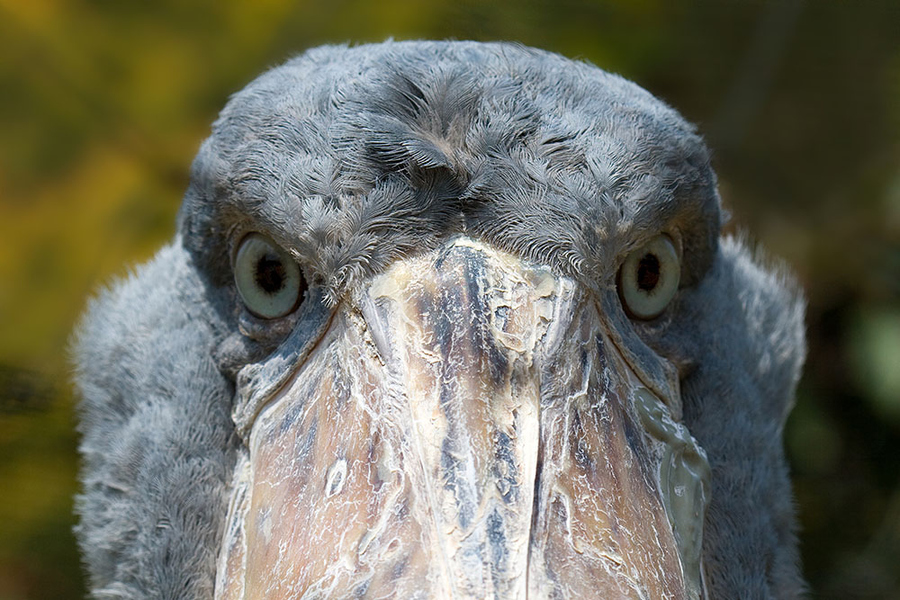
The Life of Animals | Shoebill | Distributed in tropical freshwater marshes of Southern Sudan Centre through parts of eastern Zaire, Rwanda, Uganda and western Tanzania. The distribution of this species seem to agree largely with papyrus and lungfish. The Shoebill is not migratory, with small movements due to seasonal changes in food availability and human disturbance habitat. The Shoebill is large freshwater swamps and dense. Nearly all wetlands that attract species of Cyperus papyrus and reeds Phragmites and Typha silence. More rarely, the species has been seen feeding in rice fields and flooded plantations. The Shoebill is a large bird with a large typical height of 110-140 cm (43-55) and some specimens can reach up to 150 cm (59 inches). Weight went 4-7 kg (8.8 to 15 lb) in Shoebill. The signature feature of this case is its huge bulbous bill is pale yellow with gray blotches.


pointed jaws Shoebill help decapitate their prey and also to remove any vegetation after the captured prey. Dark legs are sufficiently long, with a length of 21.7 to 25.5 cm tarsus (8.5 to 10.0). The feet of the Shoebill is exceptionally large, with the middle finger reaches 16.8 to 18.5 cm (6.6 to 7.3 inches) long. The neck is relatively shorter and thicker than other long-legged wading birds such as herons and cranes. Concussions Change, about 150 branches per minute is the slowest of almost any bird, except larger species stork. The plumage of adult birds is blue-gray with dark gray slate feathers flying. When we are born, Shoebills smallest letter, which is mainly gray silver. The Shoebill is attracted to shallow water fish often when oxygenated surface to breathe.


Shoebills usually feeds in muddy water, being solitary birds, forage at a minimum distance of 20 m (66 feet) of each other. This species is still patiently for prey slowly and watch. While hunting, Shoebill steps very slowly and often remains. Unlike some other wading birds, this species hunts conducted entirely with vision and do not know s' participate in the search for reality. Often, water and vegetation is removed during the strike and left edges of the jaw. Shoebills are largely piscivorous predators, but are assured of an impressive array of wetland vertebrates. Other prey consumed by this species, including frogs, water snakes, crocodiles and Nile monitor for children. There were also reports Shoebills simple Lechwe calf feed, even if confirmation is required. Because of its sharp beak, making a curve too high and wide, the Shoebill can hunt prey much larger, often target larger prey than other waders.

Bangweulu Swamps in Zambia, the main prey fed to young parents was Clarias mossambicus (catfish) and water snakes. In Uganda, catfish and lungfish mainly feed the young. was the solitary nature of Shoebills extending their breeding habits. Nests usually occur within 3 nests per square kilometer, unlike herons, cormorants, pelicans and storks nest in colonies. The couple farm Shoebills vigorously defend a territory, from February to April km2 (0.77 to 1.5 square miles) by his peers. North and south of the distribution of the species, nesting begins immediately after the rainy season. Birds build their nests on the floating platform, after crossing an area of about 3 m (9.8 ft) in diameter. The nest big flatbed is often partially submerged in water up to 3 meters (9.8 feet) deep. The hierarchy and the bridge are of aquatic vegetation. The eggs measure 80-90 mm (3.1 to 3.5 inches) in height from 56 to 61 mm (2.2 to 2.4 inches) and weighs about 164 g (5.8 oz). 


Envol is 105 days and Young birds can fly well, with 112 days. Shoebills small need three years until they reach full sexual maturity The Shoebill. usually silent but intimidation screens nest bill. chicks and adults participate in the cash bill during the breeding season, as a means of communication. There are images depicting the Egyptian Shoebill while the Arabs referred to the bird markub Abu, which means one with a shoe, a reference to the birds distinctive bill
Find The Life of Animals

Glossy Ibis


The Life of Animals | Glossy Ibis | This is the most common species of ibis, breeding in scattered sites in warm regions of Europe, Asia, Africa, Australia and the Atlantic Ocean and the Caribbean region of the Americas. This species is migratory, European birds overwinter in North Africa and North Carolina birds in winter to the south. Birds from other populations may greatly spread outside the breeding season. The breeding population in temperate regions during the local spring, while the tropical nesting populations, coinciding with the rainy season. Nests are often in mixed species colonies. Glossy Ibis feeding in very shallow water and litter in fresh or brackish water wetlands with high dense stands of emerging vegetation such as reeds, papyrus and reeds) and low trees or shrubs. They show a preference for the marshes at the edges of lakes and rivers, but also in lakes, floodplains, wetlands, swamps, lakes, lagoons, fields and irrigated farmland available.


In dense stands of emerging vegetation, small trees or shrubs The Black Ibis seaonand diet is highly dependent on what is available. Prey contains adult insects and larvae and water beetles, dragonflies, damselflies, grasshoppers, crickets, flies and caddis flies, leeches, worms, including, for example, molluscs (snails and clams), crustaceans (crabs and lobsters, for example) and off and far, fish, amphibians, lizards, snakes and small birds chicks such a medium ibis.


The body weight of the ibis may 485-970 g (1.07 to 2.1 pounds) vary. Breeding adults have reddish-brown bodies and shiny bottle-green wings. This species has a brown beak, dark facial skin bordered above and below blue-gray (non-breeding) to cobalt blue (breeding), and legs reddish brown. Unlike herons, ibises fly with necks outstretched, their flight is graceful and often in V-formation.


The Glossy Ibis is a way in which the Agreement on the Conservation of Migratory Waterbirds Waterbirds (AEWA) applies. Sichler be increased by habitat destruction and loss of wetlands through drainage, salinity, groundwater extraction and the invasion of exotic plants threatened.


Find The Life of Animals

Saturday, September 15, 2012

Blue Grosbeak


The Life of Animals | Blue Grosbeak | Blue Grosbeak (Passerina caerulea, formerly Guiraca caerulea) is an average of granivorous birds in the same family as the cardinal north, "tropical" or New World buntings, and "cardinal-grosbeaks" or New grosbeaks world. Male Cardinal Blue is a beautiful bird that is almost exclusively a deep blue. It eats mainly insects, but also eats snails, spiders, seeds, grains and berries. Forage blue grosbeak on the ground and in the bushes and trees.


This type is partially open habitats with scattered trees, riparian forests, Scrub, scrub, farmland found, forest edges, fields and overgrown hedges. 

Find The Life of Animals

Painted Bunting


The Life of Animals | Painted Bunting | Male Painted Bunting is often described as the most beautiful bird in North America. Cherry hair of women and children which serves as camouflage, green, and yellow-green. The United States is basically a natural green birds, because as soon as I saw, adult women, but it is distinctive. Adult painted buntings along the flank of 21-23 cm in length, length 12-14 cm (4.7 to 5.5 in.) Painted Bunting takes an average lifespan for a family. This coastal scrub forests, thickets of shrubs and brushy areas, edges are available. In the East, maritime hammocks and scrub communities breed types.


Wintering habitat is usually on the edge of the dense vegetation of tropical forests and savannas are shrub borders. Nesting in southern Arizona, southern New Mexico, southern and eastern Texas, Oklahoma, Arkansas, Louisiana, North Florida, coastal Georgia, South Carolina and northern Mexico move to the southern bank of the South Florida , Cuba, the Bahamas winter, the coast of Mexico and Central America.


There is also a butterfly or vertical display of the body, bald, bow and quiver-screen visual displays, including wing-like display, including bouncingly flight. These screens are screens agonists conflicts with other men or women, and women are rarely used to participate in the screens. As the breeding season, the receptionist average migrate short distances. Western Birds (Cherry Painted in Arizona and usually monogamous and solitary or in pairs during the breeding season, but sometimes polygyny. nests in dense shrubs and vegetation surrounding tissue is confidential and was built by the female power. 


Females only young people do not care. predators often apple the thirst for 12-14 days, and melancholy young woman, snakes, Kingsnakes Coachwhip East, there are large snakes, such as the Black Rat Snakes and Racers. Painted Bunting male Although conspicious male reproductive plumage color of the vehicle including the Cherry huntable.
Find The Life of Animals

Wednesday, September 12, 2012

Great Argus


The Life of Animals | Great Argus | Great Argus, argus Argusianus is (in some parts of Asia also known as Phoenix) blue pheasant feathers brown with a small head red chest and neck red top, black as hair, feathers, crown and throat, red legs. Measured 160-200 cm (63-79 inches) long, including a tail of 105-143 cm (41-56 inches) and weighing 2.04 to 2.72 kg (4.5 to 6.0 pounds ). Has tail feathers very long. The most spectacular features are the huge male decorated, spacious and very elongated secondary feathers with large eyespots. The female is smaller and duller than men with shorter tail and less eye patch.


Great Argus in the jungles of Borneo, Sumatra and the Malay Peninsula in Southeast Asia spread. Unusual among Galliformes the Great Argus has no oil gland and the hen lays only two eggs. The scientific name of the Great Argus was given by Linnaeus in relation to the many eye pattern on wings. Argus is a giant with a hundred eyes in Greek mythology.


Find The Life of Animals

Sunday, September 9, 2012

California Quail


The Life of Animals | California Quail | The California Quail is a highly sociable bird that often gathers in small flocks as "habits of highly effective" known. A group of quail will select an area where the soil was re-shot or soft, and under the belly dig down into the soil some 1-2 inches. Then agitated in the wells that have created, with wings beating and ruffled his feathers, raising the dust in the air. They seem to prefer sunny places in which to create these dust baths. When surprise, these birds explode into short rapid flight, called "flushing".


After hatching, the young adults. The men associated with families are not always the genetic fathers. In good years, the females will lay more than one clutch so that young people born with male and associated with the installation of a new clutch, often associated with another male.


They have a variety of vocalizations including social called "Chicago" to "seed" and warning "pip". During the mating season, the men say the competition "Bluestar" and often interrupt the social Mate called "Chicago" with a "Blue Star", a possible form of antiphonal singing vocation.


Find The Life of Animals

Horned Guan


The Life of Animals | Horned Guan | The Horned Guan is Oreophasis derbi anus large, about 85 cm long, turkey-like bird with a polished black upperparts plumage, red legs, white iris, yellow beak and a red horn on the top of the head. The young is duller with smaller horn and has brown tail and wings. The only member in monotypic genus Oreophasis the Horned Guan is distributed in humid mountain forests in southeastern Mexico (Chiapas) and Guatemala in Central America.


The Horned Guan Guan is not real, but only see these birds most general form and color, while the horn is more reminiscent of the helmeted curassows. Since the basic relationships of the living cracids not well resolved, the Horned Guan often in a separate subfamily of Oreophasinae.


Find The Life of Animals