Showing posts with label Lemur. Show all posts

Friday, August 3, 2012

Indri


The Life of Animals | Indri | In collaboration with the diadem Sifaka, Indri lemur is the largest still in existence. The Clinger and Indri is a vertical leaper and thus holds its body upright on a journey through the trees or branches of peace. Unlike any living lemur, the Indri has only a rudimentary tail. The silky fur is mostly black with white spots on the limbs, neck, crown, and lower back. Different populations of the species show large differences in color, with some populations of North consisting mainly or exclusively of black people. The face is pale with a black bare skin, and is sometimes trimmed with white fur.


Because of these color variations, Colin Groves listed two subspecies of Indri in 2005: the Indri Indri, the black part of its northern and relatively pale Indri indri variegatus in the southern part. Later editions of lemurs in Madagascar by Russell Mitter Meier et al. not to recognize this division, and recent work suggests that morphological and genetic variation in the Indri is clinal. The Indri practices long-term monogamy, seeking a new partner after the death of a partner. It lives in small groups, composed of male and female offspring mated and mature. In more fragmented forests of their range, the Indri live in large groups with several generations.


The Indri is sleeping in trees about 10-30 meters above the ground and used to sleeping alone or in pairs. It is a game for young indri common, sometimes grown women, too quiet, struggling somewhere between a few seconds to 15 minutes. Indri reach sexual maturity between the ages of 7-9. Females carry indri every two to three years, with a gestation period of 120-150 days


The Indri reaches sexual maturity between seven and nine years is a relatively slow speed, the indri known for its strong, distinctive songs, which can last from 45 seconds to 3 minutes more, well known. Song length and structure varies between and within groups, but most songs have the following three phases reason.


It is customary to coordinate this for two or more Indri, the time to get the notes to form a duo. Several groups used to sing one after the indri, react with each other. In addition to strengthening the contacts between groups, the songs can communicate and limits of territorial defense, environmental conditions, the reproductive potential of the group members, and warning signs The Indri after disturbances such as lightning , airplanes, birds and other calls of lemurs can sing.


Daily frequency of the song is at its peak during the breeding season of the indri from December to March. Several other Indri sounds were identified. The Indri emit a warning "cry" or "honk" on terrestrial predators such as the pit. To strengthen their song, the Indri to move up the tree before calling, which allows them to hear about 3-4 km wide.An Indri caught him and carried him to safety. Most legends establish a closer relationship between the Indri and humans. This brother was the first man and the brother who had remained in the forest, the first Indri. The Indri cries in mourning for his lost brother An explanation of the Babakoto name, is that the calls of the Indri was a father to his prodigal son demanded similar. When the son has also disappeared, the rest of the villagers ventured into the forest looking for two but he discovered that two large lemurs sitting in the trees: the first Indri. It is easy to see why the Indri is so closely identified with the people. Her long legs, body position upright large, the lack of a prominent tail, vocalizations and complex systems of communication are all reminiscent of human traits. Another feature of the Indri-human, as is its behavior in the sun. As his parents Sifaka, the Indri frequently engaged in what was for sunbathing or sun worship described.
Find The Life of Animals

Tuesday, April 10, 2012

Philippine flying lemur

  
The Life of Animals | Philippine flying lemur | Although as a flying lemurs, it can not fly and is not a lemur. The Philippine Flying Lemur is one of the two living species of the order Dermoptera. The other type is the Sunda Flying Lemur.  It has a broad head, small ears and large eyes. His claws are large and webbed feet for fast climbing and for gliding. The 12 inch (30 cm) tail is connected to the front legs of a flying membrane. This membrane, it is helpful to glide distances of 100 meters or more, useful for finding food and escape predators such as the Philippine Eagle. Its 34 teeth resemble those of a carnivore but the Philippine flying lemur eats mainly fruits, flowers and leaves.


The female Philippine flying lemur gives birth to one cub usually after a two month gestation period. The Philippine Flying Lemur is arboreal and usually resides in primary and secondary forests. The Philippine Flying Lemur is endemic in the Philippines.

Sifaka


The Life of Animals | Sifaka | Sifakas are a genus (Propithecus) from the family of lemurs Indriidae within the order Primates. All species of sifakas are endangered, from vulnerable to endangered. Sifakas are medium indrids with a head and body length of 40 to 55 centimeters (16 to 22) and a weight of 3 to 6 kg (6.6 to 13 lb). The round, hairless face is always black. Like all lemurs, sifaka has special adaptations for the care, including a toilet-claw on its second toe and a heart and kidney Sifakas move by vertical clinging and leaping, that is, they maintain an upright position, jumping from tree to tree trunk and branches along.


On the ground they move sideways like all indrids legged hopping movements with the hind legs, its front legs to keep balance. Sifakas are diurnal and arboreal  Sifakas are herbivores feeds on leaves, flowers and fruits Sifakas live in larger groups than the other indrids (up to 13 animals). Edges of different sifaka territories can overlap. Even if they defend their territory from invasion by others of their kind, they can peacefully co-exist with other lemur species such as Red-bellied Lemur and the Common Brown Lemur.


Thursday, January 12, 2012

Lemurs


The Life of Animals | Lemurs | Ranging in size from the 30 g (1.1 oz) Madame Berthe's mouse lemur, the world's smallest primate, to the recently Extinct 160-200 kg (350-440 lb) Archaeoindris fontoynonti lemurs evolved diverse forms of Locomotion, varying levels of social complexity, and unique adaptations to the local climate. Lemurs lack any shared traits That Make Them stand out from all other Primates. Different types of lemurs have evolved unique combinations of unusual traits to cope with Madagascar's harsh, seasonal climate.


Most of the approximately 100 species and subspecies of lemurs are either Threatened or endangered.  Until recently, giant lemurs existed on Madagascar. Now Represented only by recent or subfossil Remains, They were the resource persons were the resource persons That once modern forms part of the rich diversity of lemurs That has evolved in isolation. Large parts of Madagascar, the which are now devoid of forests and lemurs, primates once hosted diverse communities That included more than 20 lemur species covering the full range of sizes lemurs.

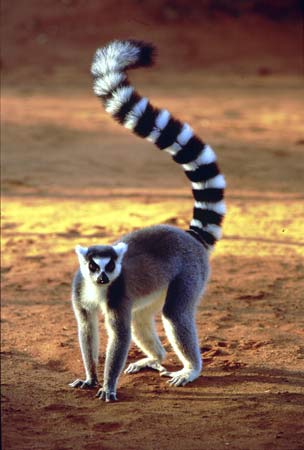
Lemur behavior is as variable as lemurs morphology. Differences in diet, social systems, activity patterns, Locomotion, communication, predator avoidance tactics, breeding systems, and intelligence levels help define lemur taxa and individual species set apart from the rest. Although trends frequently distinguish the Smaller, nocturnal lemurs from the larger, diurnal lemurs, there are exceptions Often That help exemplify the unique and diverse nature of these Malagasy Primates. Lemur communication can be transmitted through sound, sight, and smell (olfaction). The ring-tailed lemurs, for instance, uses complex though highly stereotyped behaviors Such as scent-marking and vocalizations.

Olfaction is particularly Important to lemurs, except for the indri, the which lacks most common lemur scent glands and has a greatly reduced olfactory region in the brain.  Small, nocturnal lemurs Their mark territories with urine, while the larger, diurnal species use scent glands located on Various Parts of Their anatomy. The ring-tailed lemurs engages in "stink fights" by rubbing its tail across scent glands on its wrists, and then flicking its tail at other male opponents. Latrine can Represent territorial marking behavior and aid in interspecies signaling

Compared to other Mammals, Primates in general are very vocal, and lemurs are no exception Some lemur species have extensive vocal repertoires, including the Ring-tailed Lemurs and ruffed lemurs. Some of the most common calls are lemurs Among predator alarm calls. Lemurs not only respond to alarm calls of Their own species, but also the alarm calls of other species and Those of non-predatory birds. The Ring-tailed Lemurs and A Few other species have different calls and reactions to specific types of predators. Ing with calls, it has been shown That mouse lemurs That can not be discerned Visually respond more strongly to the calls of Their own species, particularly exposed to the calls of other mouse lemurs That They would normally encounter within Lemurs calls Their home range can also be very loud and carry long distances.

Unlike anthropoid Primates, the lemurs grooming seems a to be more intimate and mutually, Often directly reciprocated. The Ring-tailed Lemur is known to be very tactile, spending the between 5 and 11% of its time grooming. Except for the aye-aye and the Lac Alaotra gentle lemur, lemurs are seasonal Breeders with very short birth seasons ing and highly influenced by the seasonal availability of resources in Their environment. Both in the aye-aye and Lac Alaotra gentle lemur, birth (parturition) Occurs over a six-month period.

Their time Lemurs birth and weaning seasons so That all periods are synchronized to match the time of highest food availability Occurs either before weaning or shortly after the Eruption of the first permanent molars in lemurs. Mouse lemurs are Able to fit Their entire breeding cycle into the wet season, whereas larger lemurs, sifakas Such as, the must lactate for two months During the dry season.  Scent factors heavily into lemur reproduction.  Monogamous lemurs include the red-bellied lemurs (Eulemur rubriventer) and the Mongoose lemur (Eulemur mongoz), although the Mongoose Lemur has been observed outside of its pair bond.  In mouse lemurs, males utilize sperm plugs, developed enlarged testes ing During the season, and develop size dimorphism (Likely due to the enlarged testes).

The gestation period varies within lemurs, ranging from 9 weeks in the mouse lemurs and dwarf lemurs in 9-10 weeks to 18-24 weeks in other lemurs. The Smaller, nocturnal lemurs, Such as mouse lemurs, giant mouse lemurs, dwarf lemurs and, usually give birth to more than one infant, whereas the larger, nocturnal lemurs, Such as fork-marked lemurs, sportive lemurs, and the aye-aye usually have one offspring Dwarf and mouse lemurs have up to four offspring, but Both averages only two. Ruffed lemurs are the only large, diurnal lemurs to consistently give birth to two or three offspring. All other lemurs have single births. Multiple births in lemurs are normally fraternal, and are known to occur in every five to six births in the species Such as the ring-tailed lemurs and some Eulemur. 

Species That Park Their offspring include nocturnal species (eg mouse lemurs, sportive lemurs, and dwarf lemurs), bamboo lemurs, and ruffed lemurs. In the case of the ruffed lemurs, the young are altricial and the mothers Build Nests for Them, much like the Smaller, nocturnal lemur species Woolly lemurs are unusual for nocturnal lemurs Because They Live in cohesive family groups and carry with Them Their single offspring rather parking than Them. Alloparenting (multiple or group parenting) has been reported in all families except the sportive lemur lemurs and aye-aye.

Allonursing is also known to occur in Several lemur groups. Even males have been observed in caring for infants Such species as the red-bellied lemurs, Mongoose lemurs, eastern lesser bamboo lemur, silky sifaka, fat-tailed dwarf lemur, and ruffed lemurs. Yet another trait That sets apart from most lemurs Primates anthropoid Their long lifespan is together with Their high infant mortality. Many lemurs, including the Ring-Tailed Lemur, have adapted to a highly seasonal environment, the which has affected Their birthrate, maturation, and twinning rate (r-selection).  In 1960, it was thought That Could lemurs live the between 23 and 25 years.