Showing posts with label Primate. Show all posts

Thursday, August 9, 2012

Uacari


The Life of Animals | Uacari | Uacari is the common name for New World monkeys of the genus Cacajao. The uakaris are unusual among New World monkeys in the tail length (15-18 cm) is considerably smaller than its head and body length (40-45 cm). Their bodies are covered with long hair and loose, but their heads are bald.


The Uacari Calvo is north and south of the Amazon River, the Sustainable Development Reserve Mamirauá Japurá. The Black-headed Uacari is north of the southern Amazon and Rio Negro. The Fog Uacari is north of the Rio Negro, west of Rio Marauia Casiquiare and east of the canal. Uakari be found in the Amazon flooded neotropical forests or wetlands, including Brazil, Colombia, Peru and Venezuela


Find The Life of Animals

Thursday, May 10, 2012

Talapoin


The Life of Animals | Talapoin | Talapoins are two types of Old World monkeys classified as genus Miopithecus.  With a typical length of 32-45 cm and a weight of 1.3 kg (males) and 0.8 kg (females), the smaller the Talapoins are Old World monkeys. Talapoins are diurnal and arboreal, prefers tropical mangrove forests and near water. As Allen swamp monkey, they are good swimmers in the water and look for food. These animals live in large groups of 60-100 animals. The groups are composed of several males, mature females and their numerous offspring.


The vocal repertoire is smaller, too. Talapoins are omnivorous, their diet consists mainly of fruits, seeds, aquatic plants, insects, crustaceans, birds' eggs and small vertebrates. Offspring are significantly large and well developed (infants weighing more than 200 grams and is approximately one-quarter the weight of the mother) and develop rapidly.

Proboscis Monkeys

  
The Life of Animals | Proboscis Monkeys | The proboscis monkey is dimorphic sexuality. Females medium 62 cm (24.4 inches) long and weigh as much as the male half. The proboscis monkey has a coat almost over. Dorsal skin is bright orange, red, red, brown or yellowish-brown brick. The skin is light gray, yellowish or grayish to pale orange ventral side is orange-pink. The male has a penis a scrotum red with black. Many of the paved monkey fingers. Proboscis monkeys usually live in groups consisting of one adult male, several females and their offspring. Other groups also exist, such as all-male groups and less documented species. Monkey to leave in groups, the overlapping areas, and there is little territorial behavior. Proboscis monkeys live in a fission fusion society, uniting groups with the side sleep late in the day. There are bands that are nuclear fission and fusion of groups formed.


A man of groups ranging from 9 to 19 people, while the bands may consist of up to 60 people. A man of groups generally have 3-12 people, but can be larger. Aggravated assault is uncommon among the monkeys, but less aggression occur frequently. A linear dominance hierarchy between men and women. Male by a group of men in their groups of 6-8 years to stay. Replacement of resident males appear to occur without serious aggression.Upon reaching adulthood, males leave their birth group and join all-male groups. Women sometimes leave their birth group, perhaps to avoid inbreeding or infanticide to reduce competition for food or increase their dominance status. Females reach sexual maturity at 5 years of age. The collection, both sexes a sullen face. Also sometimes singing men and women will present your background to a couple times male.Copulating harassed by sub-adults. Proboscis monkeys can engage in non-reproductive mounting, as playful and homosexual mounting.


The nose of a young grow slowly until they reach adulthood. If a resident male is replaced in some groups of one man, the children run the risk of infanticide. The monkey only lives in lowland habitats such as coastal and riverine habitat, many of which are flooded by tides. He prefers dipterocarp, mangrove forests and lowland forests in Auch, stunted swamp forests, forests, plantations of gum rubber, limestone hill forest, Nipa swamps, marshes and swamp forests Nibong large tropical forests and heathland cliffs can be found.

Wednesday, May 9, 2012

Gelada

  
The Life of Animals | Gelada | The ice is large and robust. It is covered with buff, dark brown, thick hair and has a dark face and eyelids pale. Adult males have a long hood and heavy hair on their backs. Ice has a hairless face, with a short snout, which is closer to a chimpanzee of a baboon. This patch is hourglass shaped. The male is bright red and surrounded by white hair in women is much less pronounced. Women also have buttons around the patches of your skin. Icy have also developed ischial callosities. No sexual dimorphism of the species males averaged 18.5 kg (40.8 lb) while females are smaller, averaging 11 kg (24.3 pounds). Tail length is 30-50 cm from 11.8 to 19.7 inches). Ice has several adjustments to their lifestyle and terrestrial herbivore. He has adapted resistant small fingers to pull the grass and narrow incisors, small adapted for chewing.


Mountain areas in which they live tend to be cooler and less arid plains areas.Thus, cold usually do not feel the negative effects of the dry season on food availability. Icy are the only primates that are primarily herbivores and graminivores - blades of grass up 90% of their diet. They eat both blades and grass seed. When both leaves and seeds are cold prefer seeds available. They also eat flowers, roots and rhizomes, when available, using hands to dig the last two. They also eat grasses, herbs, small fruits, vines, shrubs and weeds. During the dry season, grasses and herbs are consumed less are preferred. Eat frozen foods that primates and ungulates, and can chew your food as effectively as zebras. They are essentially cold days. At night they sleep in the sun cliffs.At edges, leave the cliffs and travel to the tops of the mountains to feed and socialize. By late morning, social activities tend to decrease and the frozen concentrated fodder.


When night activities, exhibitions of social ice before entering the sleeping cliffs When in estrus, the female basa back to one male and up wagging his tail to one side. Then the man comes and inspects the female breasts and genital areas. The female will mate up to five times a day, usually around noon. The majority of births occur at night. Newborns have a red face, eyes closed, and covered with black hairs. On average, babies born weighing 464 g. Women who have just given birth to stay on the periphery of the playback unit. Other adult females may have an interest in children and even kidnapping. Children can move independently around five months old. When men reach puberty, they gather in groups of independent breeding units instability.

Brazza monkey


The Life of Animals | Brazza monkey | This guenon has gray agouti hair with reddish-brown back, limbs and buttocks and tail white. Brazza monkey is a species with sexual dimorphism, males weigh about 7 pounds while females weigh about 4 kg. Tracks Brazza monkey through the swamps, bamboo and dry mountain forests of Angola, Cameroon, Central African Republic, Congo, Democratic Republic of Congo, Equatorial Guinea, Ethiopia, Gabon, Cherangani Hills of Kenya, Sudan and Uganda.


It's a monkey shy, territorial, living in small social groups.  Brazza monkeys communicate with a bang, waving tree branches and a variety of facial expressions and movements of predators De Brazza monkey include the leopard, humans and common chimpanzees.


Tuesday, April 10, 2012

Philippine flying lemur

  
The Life of Animals | Philippine flying lemur | Although as a flying lemurs, it can not fly and is not a lemur. The Philippine Flying Lemur is one of the two living species of the order Dermoptera. The other type is the Sunda Flying Lemur.  It has a broad head, small ears and large eyes. His claws are large and webbed feet for fast climbing and for gliding. The 12 inch (30 cm) tail is connected to the front legs of a flying membrane. This membrane, it is helpful to glide distances of 100 meters or more, useful for finding food and escape predators such as the Philippine Eagle. Its 34 teeth resemble those of a carnivore but the Philippine flying lemur eats mainly fruits, flowers and leaves.


The female Philippine flying lemur gives birth to one cub usually after a two month gestation period. The Philippine Flying Lemur is arboreal and usually resides in primary and secondary forests. The Philippine Flying Lemur is endemic in the Philippines.

Sifaka


The Life of Animals | Sifaka | Sifakas are a genus (Propithecus) from the family of lemurs Indriidae within the order Primates. All species of sifakas are endangered, from vulnerable to endangered. Sifakas are medium indrids with a head and body length of 40 to 55 centimeters (16 to 22) and a weight of 3 to 6 kg (6.6 to 13 lb). The round, hairless face is always black. Like all lemurs, sifaka has special adaptations for the care, including a toilet-claw on its second toe and a heart and kidney Sifakas move by vertical clinging and leaping, that is, they maintain an upright position, jumping from tree to tree trunk and branches along.


On the ground they move sideways like all indrids legged hopping movements with the hind legs, its front legs to keep balance. Sifakas are diurnal and arboreal  Sifakas are herbivores feeds on leaves, flowers and fruits Sifakas live in larger groups than the other indrids (up to 13 animals). Edges of different sifaka territories can overlap. Even if they defend their territory from invasion by others of their kind, they can peacefully co-exist with other lemur species such as Red-bellied Lemur and the Common Brown Lemur.


Saturday, January 14, 2012

Crab Eating macaque


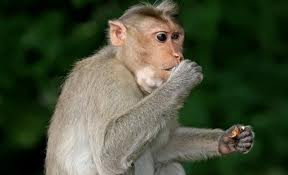
The Life of Animals | Crab Eating macaque | Depending on subspecies, the body length of the adult monkey is 38-55 centimetres (15-22 in) with comparably short arms and legs. Males are considerably larger than females, Weighing 5-9 kilograms (11-20 lb) compared to the 3-6 kg (7-13 lb) of female individuals. After a gestation period of 167-193 days, the female Gives birth to one infant. The infant's weight at birth is approximately 350 grams (12 oz). This natal coat is suggested to indicate to others the status of the infant, and other group members treat infants with care and rush to Their defensedistressed. Immigrant males Sometimes  Will not Kill Their own infants, and high-ranked females Kidnap Sometimes the infants of lower-rank females.


Mainly Young juveniles stay with the mother and relatives, and as male juveniles get older, They Become more peripheral to the group. Male crab-eating macaques, Will Groom females to increase of the chance of ing. Typically, They prefer disturbed habitats and forest periphery. The native range of this species includes most of mainland Southeast Asia, and the Maritime Southeast Asia islands of Sumatra, Java, and Borneo, offshore islands, the islands of the Philippines, and the Nicobar Islands in the Bay of Bengal.

Macaca fascicularis is an introduced alien species in Several locations, including Hong Kong, western New Guinea, Anggaur Island in Palau, and Mauritius. Where it is not a native species, particularly on Island Ecosystems Whose Often species evolved in isolation from large predators, M. fascicularis is a documented threat to many native species. This fact has led the World Conservation Union (IUCN) to list M. fascicularis as one of the "100 worst invasive alien species." insofar as it is present as an invasive alien species on Several islands, it has been labeled a "weed" species and is yet another significant ecological threat to Those Ecosystems and the species within Them.

Long-tailed macaques, extensively overlap with Their Humans across the range in Southeast Asia. Consequently, people and long-tailed macaques live together in many locations. Nafovanny, the largest facility for the captive breeding of nonhuman Primates in the world, houses 30.000 The crab-eating macaques, macaque is one of the types of monkeys That have been used as space flight test animals [citation needed]. A few cases have been documented in human, but for how long Humans have been getting malarial infections of this strain is unknown. Given the long history of Humans and macaques, living together in SE Asia, it is Likely the latter

Thursday, January 12, 2012

Lemurs


The Life of Animals | Lemurs | Ranging in size from the 30 g (1.1 oz) Madame Berthe's mouse lemur, the world's smallest primate, to the recently Extinct 160-200 kg (350-440 lb) Archaeoindris fontoynonti lemurs evolved diverse forms of Locomotion, varying levels of social complexity, and unique adaptations to the local climate. Lemurs lack any shared traits That Make Them stand out from all other Primates. Different types of lemurs have evolved unique combinations of unusual traits to cope with Madagascar's harsh, seasonal climate.


Most of the approximately 100 species and subspecies of lemurs are either Threatened or endangered.  Until recently, giant lemurs existed on Madagascar. Now Represented only by recent or subfossil Remains, They were the resource persons were the resource persons That once modern forms part of the rich diversity of lemurs That has evolved in isolation. Large parts of Madagascar, the which are now devoid of forests and lemurs, primates once hosted diverse communities That included more than 20 lemur species covering the full range of sizes lemurs.

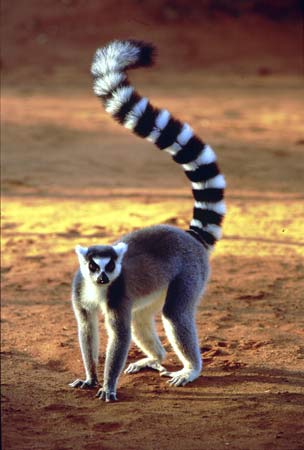
Lemur behavior is as variable as lemurs morphology. Differences in diet, social systems, activity patterns, Locomotion, communication, predator avoidance tactics, breeding systems, and intelligence levels help define lemur taxa and individual species set apart from the rest. Although trends frequently distinguish the Smaller, nocturnal lemurs from the larger, diurnal lemurs, there are exceptions Often That help exemplify the unique and diverse nature of these Malagasy Primates. Lemur communication can be transmitted through sound, sight, and smell (olfaction). The ring-tailed lemurs, for instance, uses complex though highly stereotyped behaviors Such as scent-marking and vocalizations.

Olfaction is particularly Important to lemurs, except for the indri, the which lacks most common lemur scent glands and has a greatly reduced olfactory region in the brain.  Small, nocturnal lemurs Their mark territories with urine, while the larger, diurnal species use scent glands located on Various Parts of Their anatomy. The ring-tailed lemurs engages in "stink fights" by rubbing its tail across scent glands on its wrists, and then flicking its tail at other male opponents. Latrine can Represent territorial marking behavior and aid in interspecies signaling

Compared to other Mammals, Primates in general are very vocal, and lemurs are no exception Some lemur species have extensive vocal repertoires, including the Ring-tailed Lemurs and ruffed lemurs. Some of the most common calls are lemurs Among predator alarm calls. Lemurs not only respond to alarm calls of Their own species, but also the alarm calls of other species and Those of non-predatory birds. The Ring-tailed Lemurs and A Few other species have different calls and reactions to specific types of predators. Ing with calls, it has been shown That mouse lemurs That can not be discerned Visually respond more strongly to the calls of Their own species, particularly exposed to the calls of other mouse lemurs That They would normally encounter within Lemurs calls Their home range can also be very loud and carry long distances.

Unlike anthropoid Primates, the lemurs grooming seems a to be more intimate and mutually, Often directly reciprocated. The Ring-tailed Lemur is known to be very tactile, spending the between 5 and 11% of its time grooming. Except for the aye-aye and the Lac Alaotra gentle lemur, lemurs are seasonal Breeders with very short birth seasons ing and highly influenced by the seasonal availability of resources in Their environment. Both in the aye-aye and Lac Alaotra gentle lemur, birth (parturition) Occurs over a six-month period.

Their time Lemurs birth and weaning seasons so That all periods are synchronized to match the time of highest food availability Occurs either before weaning or shortly after the Eruption of the first permanent molars in lemurs. Mouse lemurs are Able to fit Their entire breeding cycle into the wet season, whereas larger lemurs, sifakas Such as, the must lactate for two months During the dry season.  Scent factors heavily into lemur reproduction.  Monogamous lemurs include the red-bellied lemurs (Eulemur rubriventer) and the Mongoose lemur (Eulemur mongoz), although the Mongoose Lemur has been observed outside of its pair bond.  In mouse lemurs, males utilize sperm plugs, developed enlarged testes ing During the season, and develop size dimorphism (Likely due to the enlarged testes).

The gestation period varies within lemurs, ranging from 9 weeks in the mouse lemurs and dwarf lemurs in 9-10 weeks to 18-24 weeks in other lemurs. The Smaller, nocturnal lemurs, Such as mouse lemurs, giant mouse lemurs, dwarf lemurs and, usually give birth to more than one infant, whereas the larger, nocturnal lemurs, Such as fork-marked lemurs, sportive lemurs, and the aye-aye usually have one offspring Dwarf and mouse lemurs have up to four offspring, but Both averages only two. Ruffed lemurs are the only large, diurnal lemurs to consistently give birth to two or three offspring. All other lemurs have single births. Multiple births in lemurs are normally fraternal, and are known to occur in every five to six births in the species Such as the ring-tailed lemurs and some Eulemur. 

Species That Park Their offspring include nocturnal species (eg mouse lemurs, sportive lemurs, and dwarf lemurs), bamboo lemurs, and ruffed lemurs. In the case of the ruffed lemurs, the young are altricial and the mothers Build Nests for Them, much like the Smaller, nocturnal lemur species Woolly lemurs are unusual for nocturnal lemurs Because They Live in cohesive family groups and carry with Them Their single offspring rather parking than Them. Alloparenting (multiple or group parenting) has been reported in all families except the sportive lemur lemurs and aye-aye.

Allonursing is also known to occur in Several lemur groups. Even males have been observed in caring for infants Such species as the red-bellied lemurs, Mongoose lemurs, eastern lesser bamboo lemur, silky sifaka, fat-tailed dwarf lemur, and ruffed lemurs. Yet another trait That sets apart from most lemurs Primates anthropoid Their long lifespan is together with Their high infant mortality. Many lemurs, including the Ring-Tailed Lemur, have adapted to a highly seasonal environment, the which has affected Their birthrate, maturation, and twinning rate (r-selection).  In 1960, it was thought That Could lemurs live the between 23 and 25 years.

Wednesday, December 28, 2011

Bonobos

  
The Life of Animals | Bonobos | The bonobo is Sometimes Considered to be more gracile than the Common Chimpanzee, and females are somewhat Smaller than males. It has a black face with pink lips, small ears, wide nostrils, and long hair on its head That forms a part. Females have slightly more prominent breasts, in contrast to the flat breasts of other female apes, although not so prominent as Those of Humans. The bonobos also has a slim upper body, narrow shoulders, thin neck, and long legs compared to the Common Chimpanzee.


Bonobos are Both terrestrial and arboreal. Most ground Locomotion Knuckle is characterized by quadrupedal walking. Bipedal walking in captivity, as a percentage of bipedal plus quadrupedal Locomotion bouts, has been observed from 3.9% for spontaneous bouts to Nearly 19% abundant food is provided. Multivariate analysis has shown neotenized That Bonobos are more than the Common Chimpanzee, taking into account Such features as the proportionately long torso length of the bonobos. 

Aggressive Encounters the between males and females are rare, and males are tolerant of infants and juveniles. A male's status is derived from the status of his mother. While social hierarchies do exist, rank plays a less prominent role than in other primate societies. Bonobo party size tends to Vary Because the groups exhibit a fission-fusion pattern.

Bonobos are found only south of the Congo River and north of the Kasai River (a tributary of the Congo), in the humid forests of the Democratic Republic of the Congo of central Africa.  In some instances, Bonobos have been shown to consume lower-order Primates. Some claim That Bonobos have also been known to practice cannibalism in captivity, a claim disputed by others.

Baboon


The Life of Animals | Baboon | All baboons have long dog-like muzzles; heavy, powerful jaws with sharp canine teeth; close-set eyes; thick fur except on Their muzzle; a short tail; and rough spots on Their protruding buttocks, Called ischial callosities. In all baboon species there is pronounced sexual dimorphism, usually in size but also Sometimes in color or canine development. Males of the Hamadryas Baboon species also have a large white mane. Baboons are terrestrial (ground dwelling) and are found in open savannah, open Woodland and hills across Africa. Their diet is omnivorous, but Mostly vegetarian; Yet They eat Insects and occasionally prey on fish, shellfish, Hares, birds, vervets monkeys, and small antelopes.


Baboon
behavior varies greatly Depending on the social structure of the troop. In the mixed groups of savanna baboons, each male can mate with any female. The order Among the males depends partially on Their social ranking, and fights the between males are not unusual.


Female baboons with young. Okavango Delta, Botswana There are however more subtle possibilities; Sometimes males in mixed groups try to win the friendship of females. To Garner this friendship, Groom They may help the female, help care for her young, or supply Them with food. The probability is high Those That Their offspring are young. Some females prefer Cleary Such friendly males as mates. A female initiates ing by presenting her swollen rump to the male.


This submissive gesture has many Unspoken meanings amongst the troop. Often the dominant males engage in what is known as a false-mounted, in the which They mount the submissive males. The young baboon weighs approximately one kilogram and has a black epidermis born. In Egyptian mythology, Babi was the deification of the hamadryas baboons and was therefore a sacred animal.

Tuesday, December 27, 2011

Gibbon


The Life of Animals | Gibbon | Gibbons are social animals.  In most species males, and in some also females, sing solos That attract mates as well as advertise Their territory. The song can be used to identify not only species of gibbons Which is singing but it The area is from. The best current estimates place Nomascus diverging from the other genera at ~ 8 million years ago (Mya); Symphalangus and Hylobates diverging at 7 Mya. At the species level Hylobates pileatus diverged from Hylobates lar and Hylobates agilis at 3.9 Mya; and Hylobates lar and Hylobates agilis separated at 3.3 Mya


Gibbons Many are hard to identify based on fur coloration and are Identified either by song or genetics These morphological ambiguities have led to hybrids in zoos. Interspecific hybrids, hybrids within a genus, also occur in wild-Gibbons where the ranges overlap. The sinologist Robert Van Gulik That Gibbons were the resource persons concluded widespread in Central and Southern China until at least the Song Dynasty, and furthermore, based on an analysis of references to Primates in Chinese literature and Their portrayal in Chinese paintings, that the Chinese word yuan (猿) Referred specifically to Gibbons until They were the resource persons extirpated throughout most of the country due to habitat destruction (circa 14th century).


Gibbon figurines as old as from the 3-4th century BCE (the Zhou Dynasty) have been found in China. Later on, Gibbons Became a popular object for Chinese Painters, ESPECIALLY During the Song Dynasty and early Yuan Dynasty, Yi Mùqī Fǎcháng Yuanji and excelled in painting these apes. From Chinese cultural influence, the Zen motif of the "gibbon grasping at the reflection of the moon in the water" Became popular in Japanese art as well, even though Gibbons have never Occurred naturally in Japan.